Graves the Butchers, Briston | A Norfolk Family Business
Who Notices When Someone Doesn’t Turn Up?
A butcher’s shop in Norfolk receives one or two telephone calls a day that have very little to do with meat. Someone has fallen, someone is not answering the door. Could somebody pop round and check?
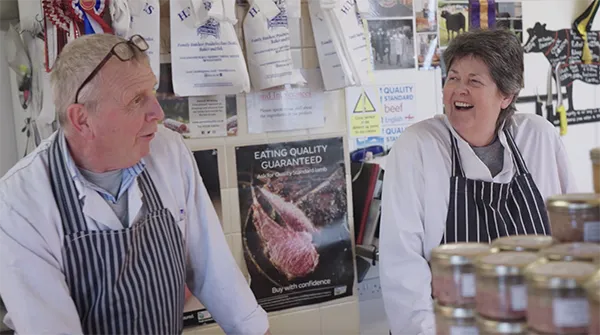
The Graves family have run their butcher’s shop in Briston for generations - and Paul Graves, now in his 60s, delivers the morning newspapers. He knows who normally appears at the door, which curtains should be open and when something feels wrong. There is no formal community-care scheme behind this.
Familiarity is a form of social infrastructure
We often talk about community as though it is something that must be organised. We look to councils, charities, healthcare providers and community groups - and all of them matter enormously. But another kind of support exists underneath those structures. It is built through repeated, ordinary contact.
The shopkeeper who knows that an older customer usually comes in on Tuesday. The neighbour who recognises that a light has not been switched on. The delivery driver who notices that newspapers are beginning to collect outside a door. None of these people necessarily thinks of themselves as providing care. They are paying attention because familiarity has made another person visible to them.
What disappears when ordinary contact disappears?
The decline of local shops is usually discussed in economic terms: falling footfall, rising costs and the difficulty of competing with supermarkets or online services. But when a long-standing shop closes, a community can lose more than somewhere to buy things.
It may also lose a place where information travels, changes are noticed and people have regular contact without needing to arrange it. The relationship might consist of little more than a greeting, a newspaper or a conversation over the counter. Yet, accumulated over years, these encounters create knowledge.
The Graves family’s story raises an important question: who notices when that everyday network is no longer there?
Community resilience begins with relationships
For organisations working in ageing, rural isolation, public health or community resilience, there is a useful lesson here.
The Graves family are an extensive 'corner' shop. But because they have remained present in the same place, serving the same families over generations, they have become part of Briston’s informal support network.
Community is not only created through large initiatives. Sometimes it is built through hundreds of ordinary encounters - and through somebody noticing when one of them does not happen.
Meet the Graves family
Watch Paul, Nichola and Ben Graves talk about family, village life and the butcher’s shop that became part of Briston’s informal support network.
Watch the Graves family film
Looking for the human story inside a bigger subject?
Relatively Speaking partners with organisations to find the people and relationships at the heart of subjects such as community, ageing, belonging and social connection - and make documentaries audiences might actually choose to watch.
Explore editorial partnerships
Return to Explore to view more articles.


