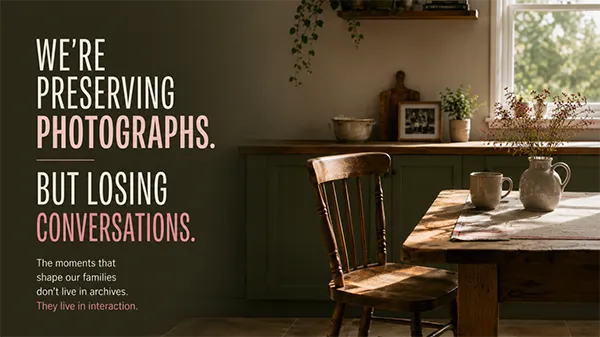
Most people think they're preserving their family history.
Most people think they're preserving their family history.
They're not, they're preserving fragments.
We keep thousands of photographs, but almost none of the conversations that explain them. We scan birth certificates, build family trees and upload DNA results, yet the thing future generations will value most is often missing entirely: what people were actually like.
The way your grandfather laughed before he finished a story. The familiar disagreement between two sisters that somehow became a family tradition. The pauses before someone answered a difficult question. The shared glance across a dinner table that said more than any words ever could.
Relationships don't live in archives, they live in interaction.
Why recording family stories matters
For most of human history, preserving family history happened almost by accident. Generations lived close together, stories were passed from grandparents to grandchildren, around dinner tables and at family gatherings.
Today, families are spread across countries, we move for work. Grandparents live independently for longer. Conversations compete with phones, deadlines and busy diaries. We assume there will always be another Christmas, another birthday, another Sunday lunch.
Then one day there isn't. And when we lose someone, we often realise that while we have hundreds of photographs of them, we never recorded the stories behind those photographs.
As a documentary filmmaker, I've noticed something else. When people know they're being genuinely listened to, they often tell stories they've never told before. Not because they've been keeping secrets, but because nobody had ever asked the right question.
A son discovers how frightened his father was when he first became a parent. A couple laugh about the argument that almost ended their marriage but ultimately strengthened it. A grandmother finally explains why she left the country she grew up in. A sibling hears, perhaps for the first time, what it was like to grow up in the same house but experience a completely different childhood.
These aren't just memories. They're context. And context changes families. It explains decisions that once looked selfish. It softens long-held resentments. It reveals resilience where people previously saw only hardship. Sometimes the greatest gift isn't discovering something extraordinary. It's finally understanding something ordinary.
Family history is more than names and dates
I think we've become very good at recording information and surprisingly poor at preserving people. Artificial intelligence will help us organise our photographs. Genealogy websites will become even more sophisticated. Searchable family archives will continue to grow. All of that is valuable. But none of it can recreate the feeling of sitting in a room while two generations tease one another over an old family story, or hearing somebody's voice crack as they remember a person they've loved for fifty years. That's the history we'll miss.
Recording family stories on film preserves something a family tree, photograph album or written family history simply can't: voices, expressions, humour, relationships and the small interactions that reveal who somebody really is.
Preserving the people, not just the photographs
At Relatively Speaking, we've built our work around a simple belief: the relationships that shape our lives deserve to be documented with the same care we give to historical events.
Through our family documentaries, we record family stories, memories and conversations - but also the relationships between people. The laughter, the disagreements, the interruptions, the things one person remembers completely differently from everyone else - in very characterful fun and emotive documentaries.
Whether we're filming a family, working with an organisation or making documentaries for our YouTube channel, we're interested in the same thing: capturing people as they really are before life changes.
Because one day, the facts will still exist. The photographs probably will too. What disappears first is everything in between.
Who in your family knows the stories nobody else knows?
If you're thinking about preserving your own family history, you can find out more about our family documentary films and how we record the people, stories and relationships you want future generations to remember.
Return to Explore to view more articles.


