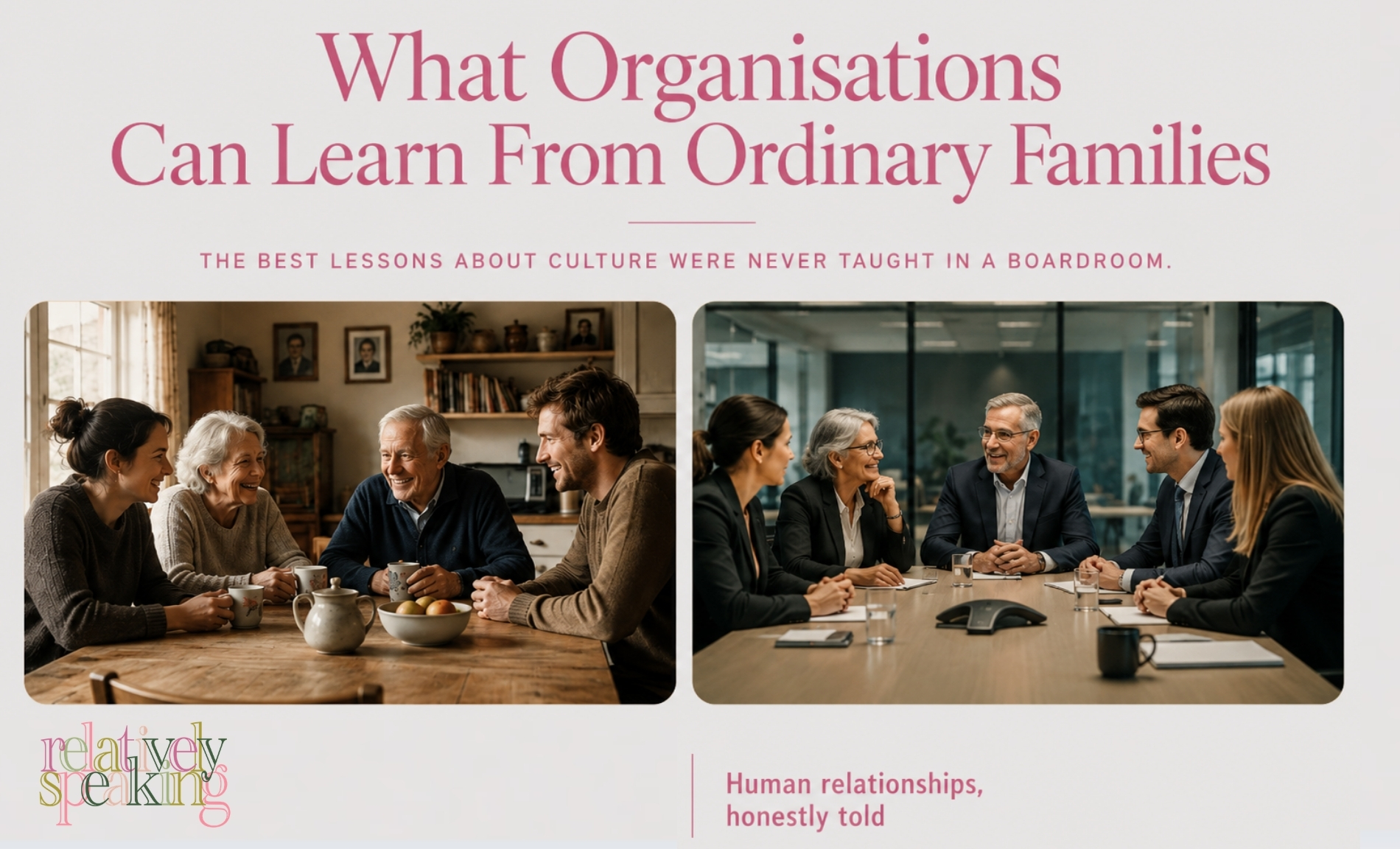
What Organisations Can Learn From Ordinary Families
Spend enough time filming ordinary families and you begin to notice something.
Around kitchen tables - between the tea-making, interruptions, old stories and disagreements - families reveal many of the things organisations are trying to understand and communicate: trust, belonging, identity, loyalty, change, care and resilience.
The difference is that families rarely talk about these things. They live them.
Values are visible in behaviour
Nobody has a values statement framed on the kitchen wall. Yet watch a family together for long enough and you quickly understand what matters to them. Families show us that values are rarely most convincing when they are announced. They are revealed through behaviour: what people notice, what they forgive, what they protect and what they do when things become difficult.
The same principle applies to organisations. A company may describe itself as caring, inclusive or rooted in its community, but those words only become meaningful when we can see what they look like in somebody’s life.
The problem with beginning with the message
Organisations understandably begin with a message:
What do we want people to know?
What do we need the film to say?
Which of our values should it communicate?
These are reasonable questions. But when they become the starting point, real people can quickly turn into delivery mechanisms for a corporate message. The contributor may technically be telling their own story, but every sentence has already been steered towards a predetermined conclusion. The film appears human, yet something feels curiously controlled.
Audiences have become very good at recognising this. They can sense when an apparently personal story has been arranged around a message rather than discovered through genuine curiosity. Documentary storytelling offers another way to begin.
Find the people who make the subject real
Instead of starting with what an organisation wants to say about itself, start with what it genuinely cares about. Then find the people and relationships through which that subject becomes visible.
Belonging is not a message, it might be found in the relationship between a recently arrived family and the neighbour who helped them feel at home.
Care is not a slogan. It might be seen between an adult child and the parent whose needs are slowly changing.
Heritage is not simply a collection of historical facts. It lives in the stories passed between generations - and in the arguments over which version of the family story is actually true.
These relationships give abstract ideas texture. They allow us to see what trust, change, loyalty or responsibility look like when they are being negotiated by real people. They also leave room for contradiction. People can be loving and exasperated, loyal and critical, hopeful and frightened at the same time. That complexity does not weaken a story. More often, it is what makes the story believable.
When the organisation does not need to be the story
Sometimes the strongest film connected to an organisation barely mentions the organisation at all. Its values may already be visible in the people it supports, the communities it belongs to, the relationships it enables or simply the issue it has chosen to care about. The organisation provides the reason the story can be told, but it does not have to occupy the centre of the frame.
Instead of asking an audience to believe what an organisation says about itself, documentary gives them something human to understand and remember. That requires a degree of trust. It means allowing real people to remain recognisably themselves, rather than polishing away the humour, awkwardness, disagreements and unexpected details that make them worth watching. But this is also where editorial value begins.
At Relatively Speaking, we do not only ask: what message do you want to communicate?
We ask: what do you genuinely care about - and whose relationships could help us understand why it matters? Because organisations do not necessarily need more content telling people who they are. Sometimes they need the human story that allows us to see it for ourselves.
If your organisation cares about something that deserves to be understood, not simply promoted, perhaps there is a relationship that could bring it to life.
Explore documentary partnerships with Relatively Speaking.
Return to Explore to view more articles.


